

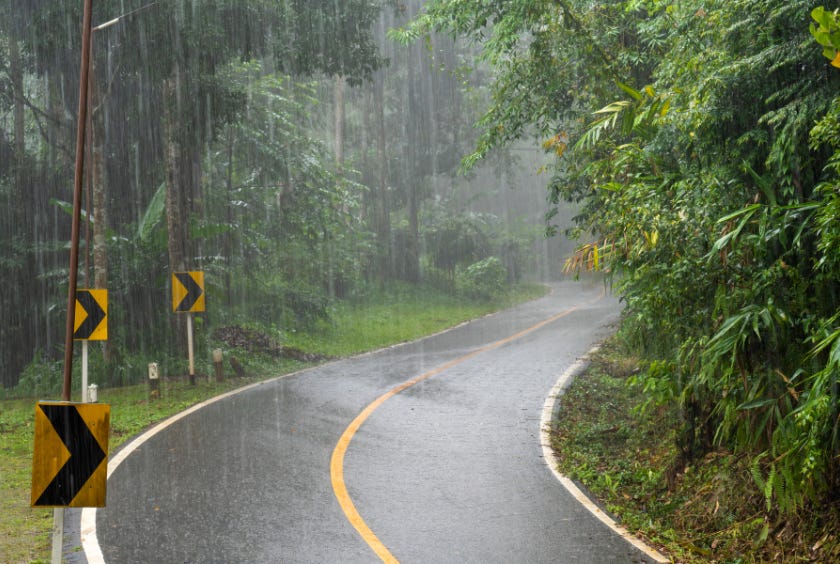
The rain starts past the last gas station, where the road narrows, and the trees lean in overhead, like they’ve been waiting for us.
I take the first curve too fast. And the next one.
I know better. The road is slick, the forest close on both sides, the thick fog rolling down off the ridges in slow drifts of mist. But there’s something in me the rain has let loose, and I don’t want to rein it in.
The harder I press the gas, the harder it falls, like my foot and the sky are running on the same current, and I couldn’t slow one without slowing the other.
Somehow, I can see it. Every drop of rain. The trees are dark enough behind the rain that each one stands out, sharp and separate, caught for a moment. I have never seen rain like this. Or, maybe, I’ve never looked.
I want to feel the truck lean into the turn. I want the wipers going, the water coming down, the mountains gray-green and folding into each other. I don’t want it to end.
Home, something in me says. Not the house. This.
I left almost everything to get here.
I wasn’t always like this.
There was a version of me who was always on. Who photographed her food before she ate it. Who read every comment, answered every message, framed every ordinary moment by how it might be shared. My office with my certificates. My phone screen. My MyFitnessPal app, logging, tracking, always tracking. Always searching for the next thing. And whatever I found was never the thing.
I did it gladly. For years, I chose this, wanted this. It gave me things I wanted, needed: control over my time, my days, where I lived. A freedom. It let me be home with my children. I built this life on purpose, and it gave me almost everything I asked of it.
There was a lot of joy in it. I liked the connection. I liked helping people. I liked that people liked me, that I appeared like I had everything together.
But it wasn’t me. Not this version of me, anyway. And I tried. For so many years, I tried…to make it me.
I wasn’t looking for a diagnosis. I was looking for permission.
I’d taken a personality test…one of those long ones that asks you a hundred small questions and then tells you something about yourself. I wanted to know whether writing was a good fit for me. I had spent so many years exhausted by work I was good at, work that never quite fit, and I didn’t want to do that again.
The results came by email. I read them on my phone.
It was gentle about it. Soft, even. It said I showed many of the markers of someone with ADHD. That I appeared to be a high masker — someone who had spent a long time overcompensating for struggles no one could see. That I might want to look into this further.
I read it twice.
All those years, I thought I was succeeding: I was compensating. My over-preparing. My feeling of being on. The way I needed the people I loved to love me so much, so visibly, so I could be sure. My feeling like I was broken because I couldn’t just do what I needed to, what Dustin needed me to.
I could lose hours, whole days, breathless, to something I loved. But I could not fake it. Not for the marketing, not for the feed, not for the parts of the work that ran on performance. The same thing that let me disappear into what mattered made everything else impossible to sustain.
I learned this is called hyperfocus with ADHD.
I thought that was just me. My personality. My work ethic. My too-much.
It had a name. It had always had a name.
The work was never the hard part. Being me was the hard part — even if it also came with superpowers.
(I did go get the real diagnosis, later. Not to fix anything, but just to stop arguing with myself about whether it was allowed to be true.)
For most of my life, my next move would have been to find the flaw, build a system, manage it, and smooth it over until no one could see the seam. That’s what I did for years: always masking.
But something in me had already stopped. Somewhere on that road in the rain, taking the curves too fast, I think I’d already let go of the idea that I was a problem to be solved. I hadn’t really overthought that part.
Reading that email, I understood, almost immediately: There was no fixing me. There was only her: the one I’d been holding at arm’s length my whole life, and I reached back and took her hand. My hand.
What went away, mostly, was the guilt. Maybe the pain, too.
For years, I was furious at myself. Why couldn’t I just do the thing? Why was this part so hard when it was easy for everyone else? What was wrong with me? What did I need to fix, to understand, to finally get right? I lived at the bottom of that question.
Now, I leave my keys on the table where I’ll never think to look for them, and I catch myself laughing with me. Because I know why now. I finally know why.
It doesn’t fix the keys. I still lose them. But I don’t lose myself over it anymore.
That's what I felt, on that winding road in the rain, when I said I left almost everything to get here. I did. I left a whole life. But not everyone came with me.
One of my children is out in the world right now, chasing something of her own. Away from us. She has more will than I did at her age, more than I even have now. She has a clearer sense of the thing she’s running toward. And she is happiest, I’ve learned, when she is untethered. When she is not ours to hold, but her own.
I want that for her. I want it down to my bones.
Yet, there is a version of me who feels the distance like weather. Who knows this is the beginning of a longer leaving, that she is becoming herself somewhere I cannot follow, and that my job is to be glad.
I have made my peace with it, mostly.
The personality test never answered my question on whether writing might be a good fit for me. It did something stranger: It opened a hole.
Right along the seam I’d spent my whole life smoothing over. A dark little tear in the story I’d been telling about myself. I thought it would swallow me. Instead, I climbed through it.
That’s where I found the answer. In a coffee shop in the mountains, Dustin across the table, my Americano still warm in my hands, my laptop open, a post for Proving Her Wrong taking shape on the screen.
I get to write for me. I get to be me. I get me.
By the time we turned onto the gravel road, the rain had stopped.
Not slowed: stopped. As if it had only ever been there to bring us home, and now that we were, it could go. I cut the engine. The quiet came in — a mountain quiet, the kind I can’t get enough of now.
Nothing here is settled yet. We’re not all the way moved. There is still so much in Austin, a house not fully ours, rooms that don’t know me yet. Part of my heart is out in the world, becoming someone I’ll have to keep letting go of.
And still, I sat there in the truck, and I was whole.
Not fixed. Not finished. Not smoothed over until you couldn’t see the seam. Just whole. The way a thing is whole when all its pieces are finally in the same place, even the broken ones. Especially the broken ones.
I finally feel like I’m getting somewhere.
Even if I had to break everything to get here.
Proving Her Wrong is reader-supported, and you’re the reason it exists. If this one stayed with you, leave a comment. I read every one.
Lacey Baier is a writer of personal essays about the messy, unfiltered journey of becoming who you were always meant to be. She’s the author of two cookbooks and the founder of Sweet Pea Chef and Cleanish. She’s currently writing her first novel.